Work in progress, please don't share, but do feel free to get involved!
In past posts we've built a simulator and a workload generator and checker for distributed systems. The assumption we made is that if the distributed system we are building is deterministic, then we can test it effectively. Where effectively means:
- It's fast, because we can simulate the passage of time and thus not have to wait for timeouts;
- It produces minimal counterexamples when the checker fails, because we can shrink the generated workload;
- Failures are reproducible, given the seed of the workload generator.
But how do we fulfill the assumption that our distributed system is indeed determinisitic? This is the problem we'll start tackling in this post, and we'll do so by means of introducing a domain-specific language inspired by Jepsen's Maelstrom.
Hopefully by now it should already be clear why we need determinism, but the need for a new domain-specific language deserves some explaination.
If the programming languages we were using had deterministic runtimes then we could skip this, however this is unfortunately not the case as we saw in a previous post.
In fact even seemingly pure things such as iterating over a hash map can be non-determinisitic in some programming languages (because sometimes insertion order matters).
Besides most programming languages are not very well suited for writing distributed systems out of the box, so we typically need to add ways to do:
- Message passing or RPC
- Timers for timeouts and periodic work
- Concurrency and parallelism
- Observability
Choices regarding how to do these thing idiomatically within each programming language can be overwhelming, and even more so if the distributed system uses several different programming languages.
In a way the domain-specific language that we will introduce abstracts these necessary constructs, and provides a uniform way of writing programs across languages while also achiving determinism and therefore the ability to do simulation testing.
The constructs for our doman-specific language are taken straight from Jepsen's Maelstrom, which already has been shown to be portable to many different languages while at the same time being expressive enough to implement a variety of distributed systems.
As pointed out eariler, they key difference between what we are about to do and Maelstrom is that our workload generator and runtime will be deterministic.
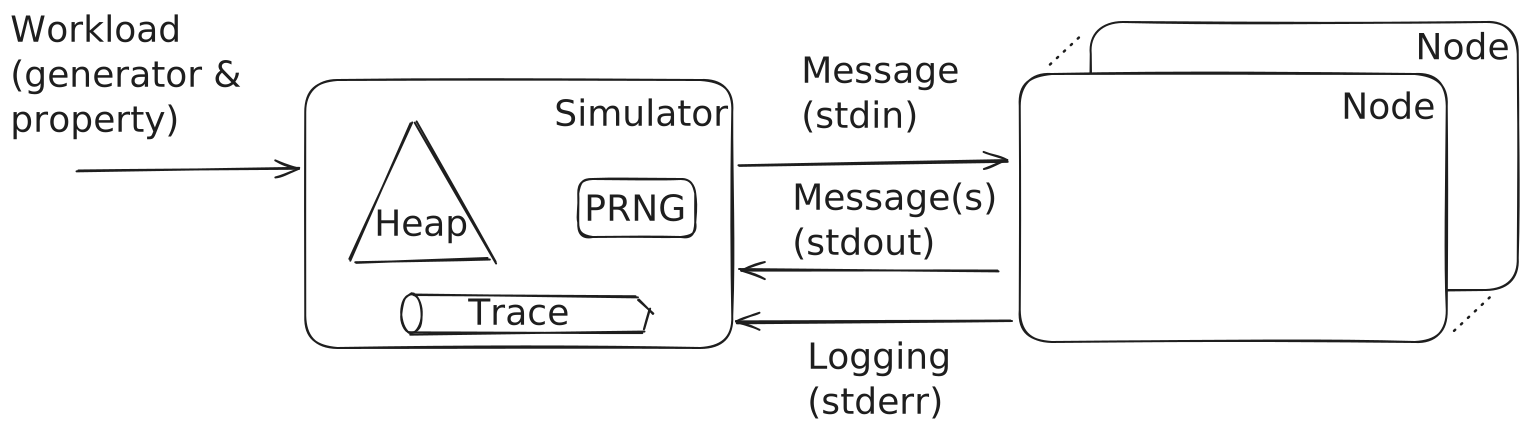
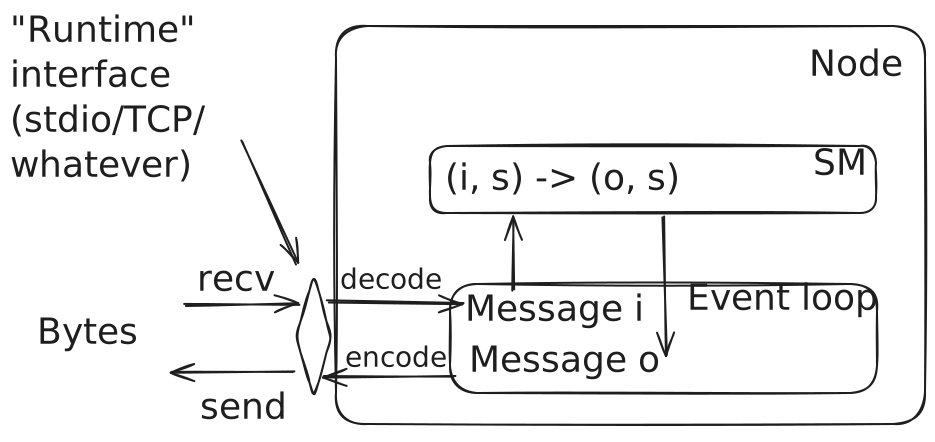
We'll start of with a the bare minimum domain-specific language able to express the echo example, and then we'll build upon this and then in future posts we'll expand the set of examples that we can implement.
A node, in the distributed system, will be the basis for our language and is merely a function from some input to a "node body":
newtype Node s i o a = Node {unNode :: i -> NodeBody s i o a}

newtype NodeBody s i o a = NodeBody {unNodeBody :: Free (NodeF s i o) a}
data NodeF s i o x
  = Reply o (() -> x)
  | Get (s -> x)
  | Put s (() -> x)
  | Send NodeId i (() -> x)
For now the node body can only express the ability to reply to an input, s. However this is already enough to express our echo example:
echo :: Node () String String ()
echo = Node $ \input -> let output = input in reply output

reply :: o -> NodeBody s i o ()
reply output = NodeBody (Free (Reply output Pure))
data Message a = Message
  { src :: NodeId
  , dest :: NodeId
  , msgId :: Maybe MessageId
  , inReplyTo :: Maybe MessageId
  , payload :: a
  }
  deriving stock (Generic, Functor, Foldable, Traversable)
  deriving anyclass (FromJSON, ToJSON)

type MessageId = Word64
data Codec i o = Codec
  { decodeInput :: Value -> Either String i
  , encodeOutput :: o -> Value
  , encodeInput :: i -> Value
  }
data NodeState s = NodeState
  { localState :: s
  , nextMessageId :: MessageId
  , self :: NodeId
  }
initialNodeState :: s -> NodeState s
initialNodeState s =
  NodeState
    { localState = s
    , nextMessageId = 0
    , self = "uninitialised"
    }
runNode ::
  Node s i o a
  -> Codec i o
  -> NodeState s
  -> Message Value
  -> Either String (NodeState s, [Message Value], a)
runNode node codec s mv = case traverse codec.decodeInput mv of
  Right mi -> Right (runNodeBody (void mv) (unNode node mi.payload) codec s)
  Left err -> Left err
runNodeBody ::
  Message ()
  -> NodeBody s i o a
  -> Codec i o
  -> NodeState s
  -> (NodeState s, [Message Value], a)
runNodeBody mv (NodeBody m) codec s = iterM go done m (s, [])
  where
    done x (s, messages) = (s, reverse messages, x)

    go (Reply o k) (s, acc) = do
      let messageId = s.nextMessageId
      let message =
            Message
              { src = mv.dest
              , dest = mv.src
              , msgId = Just messageId
              , inReplyTo = mv.msgId
              , payload = codec.encodeOutput o
              }
      k () (s {nextMessageId = messageId + 1}, message : acc)
    go (Send nodeId i k) (s, acc) = do
      let messageId = s.nextMessageId
      let message =
            Message
              { src = s.self
              , dest = nodeId
              , msgId = Just messageId
              , inReplyTo = Nothing
              , payload = codec.encodeInput i
              }
      k () (s {nextMessageId = messageId + 1}, message : acc)
    go (Get k) (s, acc) =
      k s.localState (s, acc)
    go (Put s' k) (s, acc) =
k () (s {localState = s'}, acc)- Criteria: maximal overlap between code that's tested and deployed to production
- Test deployment vs production deployment
eventLoop :: Node_ s i o -> s -> Codec i o -> Runtime -> IO ()
eventLoop node initialState codec runtime =
  go (initialNodeState initialState)
  where
    go s = do
      incoming <- runtime.receive
      forM_ incoming $ \(_time, message) -> do
        case runNode node codec s message of
          Left err -> do
            putStrLn ("Failed to parse input: " <> err)
            go s
          Right (s', outgoing, ()) -> do
            runtime.send outgoing
            go s'
data Runtime = Runtime
  { send :: [Message Value] -> IO ()
  , receive :: IO [(Time, Message Value)]
  }
consoleRuntime :: IO Runtime
consoleRuntime = do
  hSetBuffering stdin LineBuffering
  hSetBuffering stdout LineBuffering
  hSetBuffering stderr LineBuffering
  return
    Runtime
      { receive = consoleReceive
      , send = consoleSend
      }
  where
    consoleReceive :: IO [(Time, Message Value)]
    consoleReceive = do
      line <- BS8.hGetLine stdin
      if BS8.null line
        then return []
        else do
          BS8.hPutStrLn stderr ("consoleRuntime: recieved: " <> line)
          case Json.eitherDecodeStrict line of
            Right message -> do
              now <- getCurrentTime
              return [(now, message)]
            Left err ->
              error
                $ "consoleRuntime: failed to decode message: "
                ++ show err
                ++ "\nline: "
                ++ show line

    consoleSend :: [Message Value] -> IO ()
    consoleSend messages =
      forM_ messages $ \message -> do
        BS8.hPutStrLn
          stderr
          ("consoleRuntime: sent: " <> LBS8.toStrict (Json.encode message))
        BS8.hPutStrLn stdout (LBS8.toStrict (Json.encode message))
testMain :: IO ()
testMain = eventLoop echo () echoCodec =<< consoleRuntime
tcpRuntime :: Port -> Map NodeId Port -> IO Runtime

prodMain :: Port -> Map NodeId Port -> IO ()
prodMain port peers = eventLoop echo () echoCodec =<< tcpRuntime port peers
data NodeHandle = NodeHandle
  { handle :: Time -> Message -> IO [Message]
  , close :: IO ()
  }
pipeNodeHandle :: FilePath -> [String] -> IO NodeHandle
pipeNodeHandle fp args = do
  (Just hin, Just hout, _, processHandle) <-
    createProcess
      (proc fp args) {std_in = CreatePipe, std_out = CreatePipe}
  return
    NodeHandle
      { handle = \_arrivalTime message -> do
          LBS8.hPutStr hin (Json.encode message)
          BS8.hPutStr hin "\n"
          hFlush hin
          line <- BS8.hGetLine hout
          case Json.eitherDecodeStrict line of
            Left err -> hPutStrLn stderr err >> return []
            Right msg' -> return [msg']
      , close = terminateProcess processHandle
      }
blackboxTestWith ::
  TestConfig -> FilePath -> (Seed -> [String]) -> Workload -> IO Bool
blackboxTestWith testConfig binaryFilePath args workload = do
  (prng, seed) <- newPrng testConfig.replaySeed
  let deployment =
        Deployment
          { numberOfNodes = testConfig.numberOfNodes
          , spawn = pipeNodeHandle binaryFilePath (args seed)
          }
  let (prng', _prng'') = splitPrng prng
  result <- runTests testConfig deployment workload prng'
  handleResult workload.prettyFailure result seed

blackboxTest :: FilePath -> Workload -> IO Bool
blackboxTest binary = blackboxTestWith defaultTestConfig binary (const [])
simulatorMain :: IO Bool
simulatorMain = blackboxTest "/path/to/test-main-binary" workload
  where
data Deployment = Deployment
{ numberOfNodes :: Int
, spawn :: IO NodeHandle
}
With this we've got all code needed to actually run the tests for our echo example.
- Our runtime is trivially deterministic, over the next couple of posts we'll introduce more complicated examples which will require us to extend the syntax and event loop. For example we'll need some kind of asynchronous RPC construct and this won't be trivially deterministic anymore.