Conversation


|
Hi @emcpow2, thanks for the PR, but I'm not sure if this approach provides any significant advantage to what we have currently.
Could you go into more detail about what you mean here? |

|
Hey @jordaneremieff , The main purpose is to further precisely construct response objects. Response structure differs with depends on the request event. Response for ALB request with multivalue headers disabled{
"isBase64Encoded": false,
"statusCode": 200,
"statusDescription": "200 OK",
"headers": {
"Set-cookie": "cookies",
"Content-Type": "application/json"
},
"body": "Hello from Lambda (optional)"
}Response for ALB request with multivalue headers enabled{
"isBase64Encoded": false,
"statusCode": 200,
"statusDescription": "200 OK",
"multiValueHeaders": {
"Set-cookie": ["cookie-name=cookie-value;Domain=myweb.com;Secure;HttpOnly","cookie-name=cookie-value;Expires=May 8, 2019"],
"Content-Type": ["application/json"]
},
"body": "Hello from Lambda (optional)"
}Response for API Gateway Payload v1 request{
"isBase64Encoded": false,
"statusCode": 200,
"headers": {"headerName": "headerValue"},
"multiValueHeaders": {"headerName": ["headerValue", "headerValue2"]},
"body": "Hello from Lambda!"
}Response for API Gateway Payload v2 request{
"cookies" : ["cookie1", "cookie2"],
"isBase64Encoded": false,
"statusCode": 200,
"headers": { "headerName": "headerValue"},
"body": "Hello from Lambda!"
}References |
|
@koxudaxi could you take a look at this one and share your thoughts when you can? |

|
@emcpow2 However, I don't know the implementation is the best approach. 🤔
Could you explain the next phase design? |
|
This is how I see it
Long term outcomes:
That's a way we could build an extendible and cloud agnostic Lambda ASGI adapter. Feedback is welcome. I recognise I could overlook pitfalls and implementation details. Talking about the next step:
|
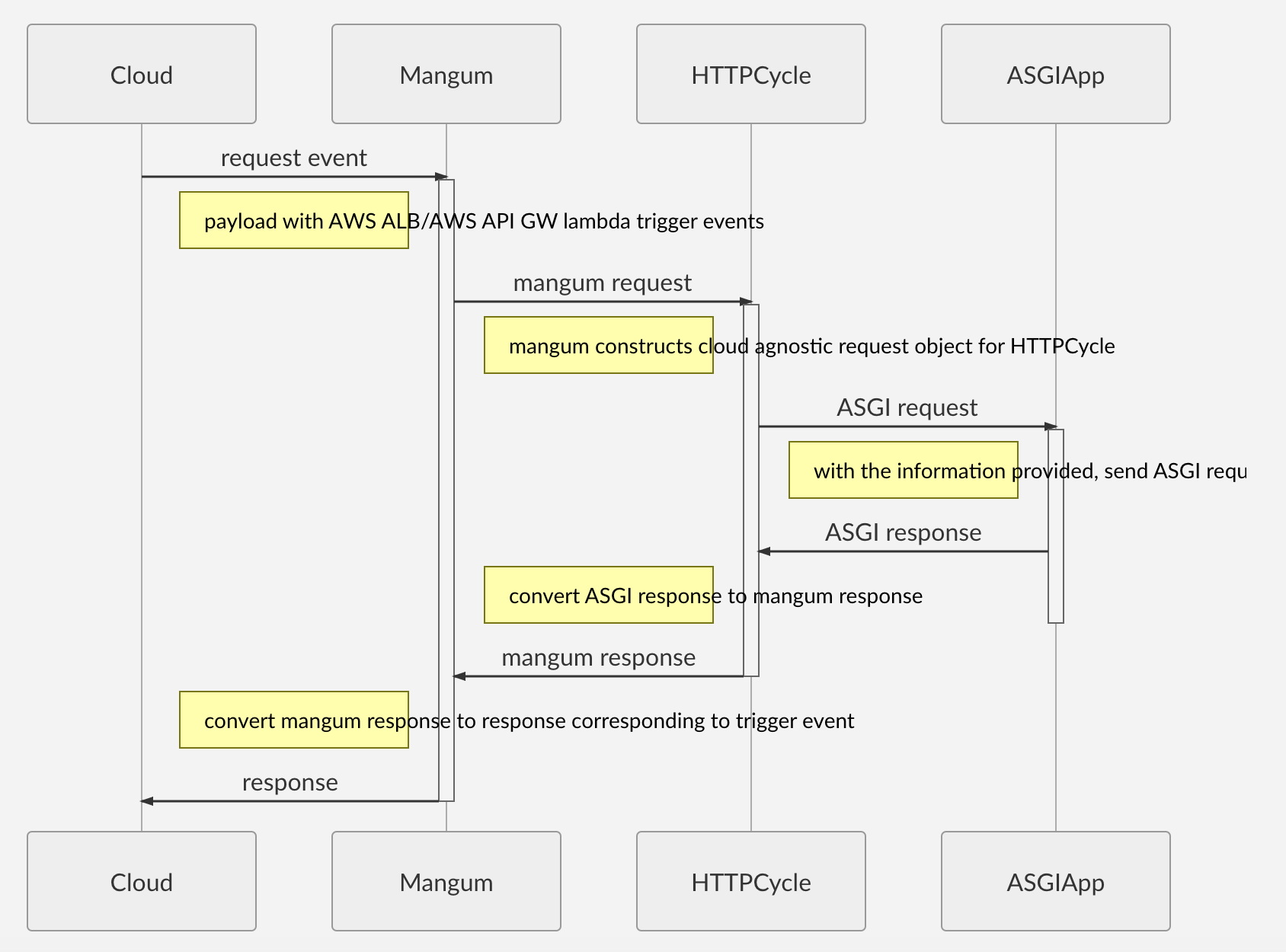
|
@emcpow2 What did you think about it? |

|
For what it's worth I think this PR looks like a step in the right direction - it clearly separates out the detection of the event source type into a nice neat element which can be reasoned about, and tested, in isolation. Construction of response based on event source type as you've suggested is a good idea too for the future. I don't see how this PR could have any tangible impact on performance. |
|
So, I've previously experimented with a few different approaches towards a similar goal, but the correct approach I think depends mostly on whether or not we want to include multi-cloud support or focus exclusively on AWS and pursue greater support for AWS features (e.g. websockets, etc.). I guess we can probably design something that accommodates multiple use-cases, but I want to be careful about the foundational pieces here because event handlers arguments and types can vary across platforms and even AWS alone has a lot of variety in the request/response structures. If we do something like this, then I think instead of additional |
|
I don't see a huge difference between various types of AWS events and an event from Google/Azure. Let's clearly state that Mangum does support a subset of cloud events, but does it in a consistent way? For instance, if AWS ALB support is declared - then there's a guarantee of 100% compliance with specs. In order to move further, we need to outline class responsibilities. So that we do not mess abstractions and have a clear design. Are these correct?
If there's an agreement to support various types of events - whose responsibility to maintain cloud-agnostic adopters? Possible solutions:
|
I consider the differences significant. For example, I've created similar projects for both in the past, and there is some nuance to how the request/responses need to be handled for both GCF and Azure. From what I recall, Google Cloud Functions use the Flask request class for events and expects either a Flask Response object, response body, or tuple to be returned. In the case of Azure, it relies on specific HTTP request and response classes from its own Python worker library, and the name of the parameter provided for the request event object can be configurable. I originally supported Azure in this project and had considered multi-cloud support at various stages, but the latest discussion around this was in this issue where I ultimately decided to focus on supporting just AWS and instead opened an issue in the official Azure repository to support ASGI (similar to how it supports WSGI). Based on an earlier comment:
It seems like the main problem currently is with understanding the response structure and making it compliant for the recently added ALB events? In this case, the PR should focus on determining where the response is non-compliant and difficult to understand without any consideration for potential use-cases for other cloud providers because supporting multiple cloud providers isn't currently in the project roadmap - to pursue that aspect further should be done in a new issue on the tracker for discussion and agreement first. |
|
@jordaneremieff , thanks for the clarifications. The reason I tried to contribute was to build something on top of mangum and add missing features to the project, and as a side effect maximizing positive impact to mangum. Fixing solely ALB issue is not my priority. I'm stepping out for now. |


4 participants


This PR is a one-step closet to support different event sources.
Also, we should construct responses according to the request type, that work is out of the PR scope though.