Affected Versions
version ≤ 2.7.8 (latest version at time of disclosure)
https://github.com/openmrs/openmrs-core
Impact
The endpoint POST /openmrs/ws/rest/v1/module is vulnerable to a path traversal (Zip Slip) attack. An authenticated attacker can upload a crafted .omod archive containing ZIP entries with directory traversal sequences. Upon automatic extraction by the server, the incomplete path validation in WebModuleUtil.startModule() fails to prevent entries such as web/module/../../../../malicious.jsp from being written outside the intended module directory. If the traversal target falls within the web application root (e.g., /usr/local/tomcat/webapps/openmrs/), the attacker achieves arbitrary file write and subsequent Remote Code Execution.
Notably, other extraction methods in the same codebase (ModuleUtil.expandJar(), TestInstallUtil.addZippedTestModules()) are properly protected with normalize().startsWith() checks — this vulnerability is an oversight where the same fix was not applied.
Furthermore, the module.allow_web_admin runtime property, which is intended to restrict administrators from managing modules via the web interface, only gates the Legacy UI controller entry point. The REST API endpoint POST /openmrs/ws/rest/v1/module does not check this property, allowing this restriction to be fully bypassed.
Steps to Reproduce
- Construct a malicious
.omod file (which is a ZIP/JAR archive) containing a ZIP entry with a path traversal payload in its entry name, such as web/module/../../../../<target_filename>. Upload this file to POST /openmrs/ws/rest/v1/module with valid admin credentials via Basic Auth.


- The server parses and loads the module. During
WebModuleUtil.startModule(), entries under web/module/ are automatically extracted. The existing check Paths.get(name).startsWith("..") only blocks entries beginning with .., so an entry starting with web/module/ passes the check. The ../ sequences in the remaining path cause the file to be written outside the intended WEB-INF/view/module/ directory — for example, into the web application root at /usr/local/tomcat/webapps/openmrs/.

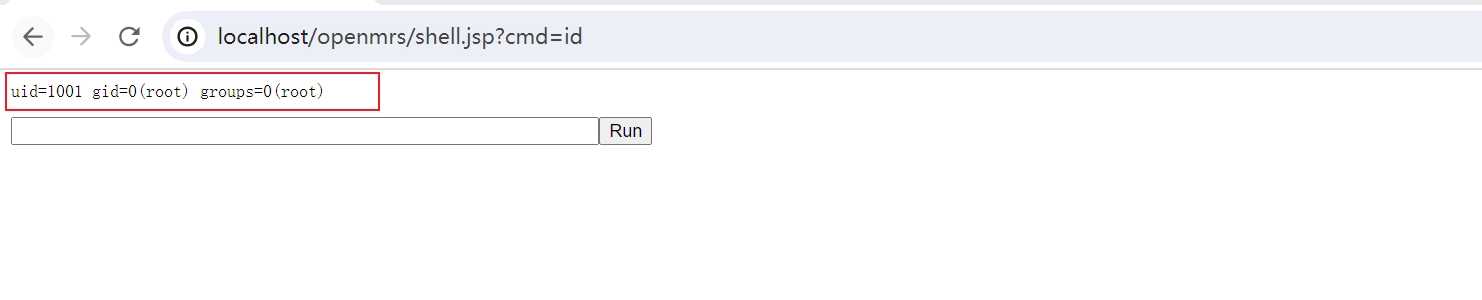
- The traversed file is now accessible under the web application root. If the written file is a JSP script, accessing it via the browser triggers server-side execution, achieving RCE.
Root Cause Analysis
The vulnerability exists in WebModuleUtil.startModule() (web/src/main/java/org/openmrs/module/web/WebModuleUtil.java).
Vulnerable code:
Enumeration<JarEntry> entries = jarFile.entries();
while (entries.hasMoreElements()) {
    JarEntry entry = entries.nextElement();
    String name = entry.getName();

    // ❌ Incomplete check — only blocks entries starting with ".."
    if (Paths.get(name).startsWith("..")) {
        throw new UnsupportedOperationException("...");
    }

    if (name.startsWith("web/module/")) {
        String filepath = name.substring(11);
        StringBuilder absPath = new StringBuilder(realPath + "/WEB-INF");
        absPath.append("/view/module/");
        absPath.append(mod.getModuleIdAsPath()).append("/").append(filepath);

        // ❌ No normalize() or startsWith() boundary check before writing
        File outFile = new File(absPath.toString().replace("/", File.separator));
        outStream = new FileOutputStream(outFile, false);
        inStream = jarFile.getInputStream(entry);
        OpenmrsUtil.copyFile(inStream, outStream);
    }
}
Why the check fails: For an entry named web/module/foo/../../../../evil.jsp, Paths.get(name) starts with web, not .., so the check passes. After name.substring(11), the filepath foo/../../../../evil.jsp is concatenated directly into the output path without normalization, resulting in a write outside the intended directory.
Correctly protected code in the same codebase:
ModuleUtil.expandJar():
// ✅ Correct — uses normalize().startsWith()
if (!parent.toPath().normalize().startsWith(docBase)) {
    throw new UnsupportedOperationException("...");
}TestInstallUtil.addZippedTestModules():
// ✅ Correct — uses normalize().startsWith()
if (!zipEntryFile.toPath().normalize().startsWith(moduleRepository.toPath().normalize())) {
    throw new IOException("Bad zip entry");
}
The fix pattern is already known and applied elsewhere in the codebase. WebModuleUtil.startModule() is an oversight.
Bypass of module.allow_web_admin
The module.allow_web_admin property only restricts module operations at the Legacy UI layer (ModuleListController). The REST API endpoint does not consult this property:
Legacy UI:  POST /admin/modules/moduleList.form → allowAdmin() check → [BLOCKED]
REST API:   POST /ws/rest/v1/module             → No allowAdmin() check → [ALLOWED]
                ↓
        ModuleFactory.loadModule()
                ↓
        WebModuleUtil.startModule()   ← Zip Slip here, no allowAdmin check
                ↓
        FileOutputStream.write()      ← Arbitrary file write
Remediation
Add normalize().startsWith() boundary validation before writing, consistent with the existing pattern in ModuleUtil.expandJar():
File outFile = new File(absPath.toString().replace("/", File.separator));

// ✅ Add this check
if (!outFile.toPath().normalize().startsWith(
        Paths.get(realPath, "WEB-INF").normalize())) {
    throw new UnsupportedOperationException(
        "Zip entry '" + name + "' would be written outside the allowed directory.");
}
Additionally, enforce the module.allow_web_admin restriction consistently across all module upload entry points, including the REST API.
References

Arron-bit Reporter
Affected Versions
version ≤ 2.7.8 (latest version at time of disclosure)
https://github.com/openmrs/openmrs-core
Impact
The endpoint
POST /openmrs/ws/rest/v1/moduleis vulnerable to a path traversal (Zip Slip) attack. An authenticated attacker can upload a crafted.omodarchive containing ZIP entries with directory traversal sequences. Upon automatic extraction by the server, the incomplete path validation inWebModuleUtil.startModule()fails to prevent entries such asweb/module/../../../../malicious.jspfrom being written outside the intended module directory. If the traversal target falls within the web application root (e.g.,/usr/local/tomcat/webapps/openmrs/), the attacker achieves arbitrary file write and subsequent Remote Code Execution.Notably, other extraction methods in the same codebase (
ModuleUtil.expandJar(),TestInstallUtil.addZippedTestModules()) are properly protected withnormalize().startsWith()checks — this vulnerability is an oversight where the same fix was not applied.Furthermore, the
module.allow_web_adminruntime property, which is intended to restrict administrators from managing modules via the web interface, only gates the Legacy UI controller entry point. The REST API endpointPOST /openmrs/ws/rest/v1/moduledoes not check this property, allowing this restriction to be fully bypassed.Steps to Reproduce
.omodfile (which is a ZIP/JAR archive) containing a ZIP entry with a path traversal payload in its entry name, such asweb/module/../../../../<target_filename>. Upload this file toPOST /openmrs/ws/rest/v1/modulewith valid admin credentials via Basic Auth.WebModuleUtil.startModule(), entries underweb/module/are automatically extracted. The existing checkPaths.get(name).startsWith("..")only blocks entries beginning with.., so an entry starting withweb/module/passes the check. The../sequences in the remaining path cause the file to be written outside the intendedWEB-INF/view/module/directory — for example, into the web application root at/usr/local/tomcat/webapps/openmrs/.Root Cause Analysis
The vulnerability exists in
WebModuleUtil.startModule()(web/src/main/java/org/openmrs/module/web/WebModuleUtil.java).Vulnerable code:
Why the check fails: For an entry named
web/module/foo/../../../../evil.jsp,Paths.get(name)starts withweb, not.., so the check passes. Aftername.substring(11), the filepathfoo/../../../../evil.jspis concatenated directly into the output path without normalization, resulting in a write outside the intended directory.Correctly protected code in the same codebase:
ModuleUtil.expandJar():TestInstallUtil.addZippedTestModules():The fix pattern is already known and applied elsewhere in the codebase.
WebModuleUtil.startModule()is an oversight.Bypass of
module.allow_web_adminThe
module.allow_web_adminproperty only restricts module operations at the Legacy UI layer (ModuleListController). The REST API endpoint does not consult this property:Remediation
Add
normalize().startsWith()boundary validation before writing, consistent with the existing pattern inModuleUtil.expandJar():Additionally, enforce the
module.allow_web_adminrestriction consistently across all module upload entry points, including the REST API.References