Skip to content

pyLoad: Server-Side Request Forgery via Download Link Submission Enables Cloud Metadata Exfiltration

Critical severity GitHub Reviewed Published Mar 25, 2026 in pyload/pyload • Updated Mar 30, 2026

Package

pip pyload-ng (pip)

Affected versions

<= 0.5.0b3.dev96

Patched versions

None

Description

Summary

PyLoad's download engine accepts arbitrary URLs without validation, enabling Server-Side Request Forgery (SSRF) attacks. An authenticated attacker can exploit this to access internal network services and exfiltrate cloud provider metadata. On DigitalOcean droplets, this exposes sensitive infrastructure data including droplet ID, network configuration, region, authentication keys, and SSH keys configured in user-data/cloud-init.

Details

The vulnerability exists in PyLoad's download package functionality (/api/addPackage endpoint), which directly passes user-supplied URLs to the download engine without validating the destination. The affected code in src/pyload/webui/app/blueprints/api_blueprint.py:

@bp.route("/addPackage", methods=["POST"], endpoint="add_package")
@login_required
def add_package():
    name = flask.request.form["add_name"]
    links = flask.request.form["add_links"].split("\n")
    # ... validation omitted ...
    api.add_package(name, links, dest)  # No URL validation

The download engine in src/pyload/core/managers/download.py accepts any URL scheme and initiates HTTP requests to arbitrary destinations, including internal network addresses and cloud metadata endpoints.

Proof of Concept

Live Demo Instance: http://143.244.141.81:8000
Credentials: pyload / pyload

  • Login into the pyload application
  • Navigate to package tab and enter the package name and fill the Link section with the following URL
http://169.254.169.254/metadata/v1.json

image

  • Now navigate to Files section and download the link.
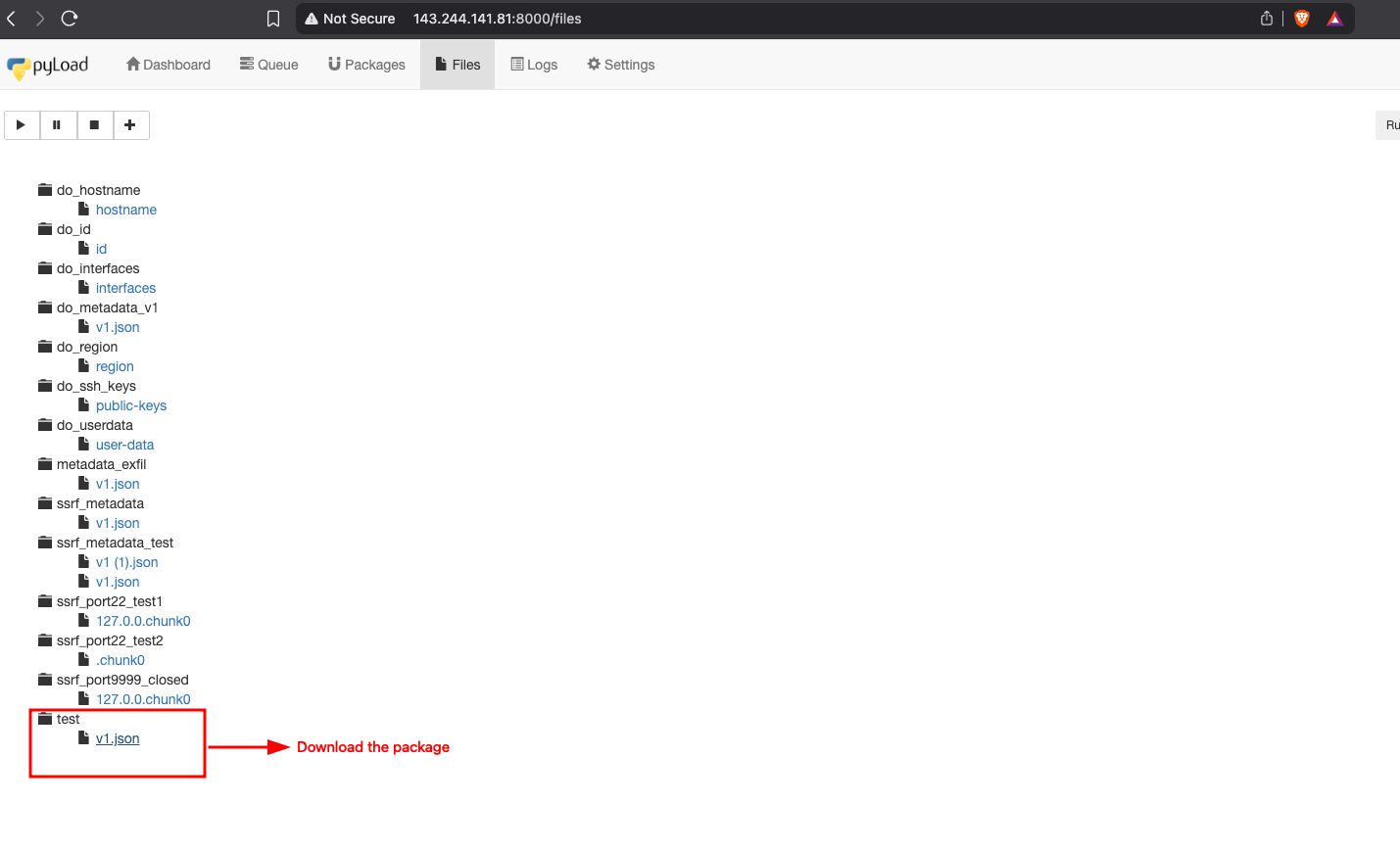
image

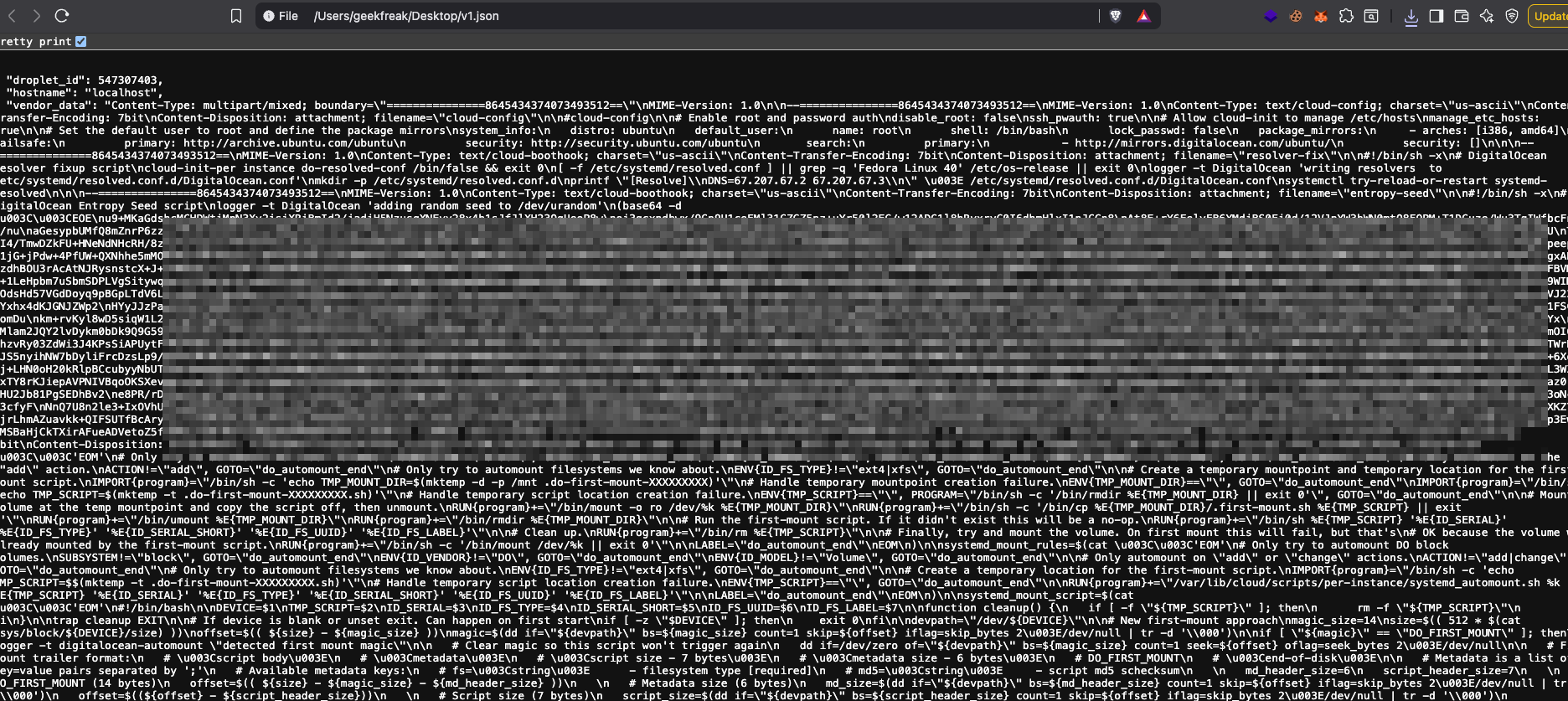
  • It was observed that we are able to Read the Digital Ocean Metadata
image

The downloaded v1.json file contains sensitive cloud infrastructure data:

  • Droplet ID: Unique identifier for the instance
  • Network Configuration: Public/private IP addresses, VPC topology
  • Authentication Keys: Cloud provider auth tokens
  • SSH Keys: Public keys configured in droplet metadata
  • Region and Datacenter: Infrastructure location

Impact

Vulnerability Type: Server-Side Request Forgery (SSRF)
CVSS Score: 7.7 - 9.1 (High to Critical, depending on cloud deployment)

Affected Systems

  • All PyLoad installations (version 0.5.0 and potentially earlier)
  • Critical Impact on cloud deployments (AWS EC2, DigitalOcean, Google Cloud, Azure) where metadata contains:
    • IAM credentials (AWS)
    • SSH private keys (configured in user-data)
    • API tokens and secrets
    • Database credentials stored in cloud-init

Attack Requirements

  • Valid PyLoad user account (any role - ADMIN or USER)
  • Network connectivity to PyLoad instance

Security Impact

  1. Cloud Metadata Theft: Complete exfiltration of instance metadata
  2. Lateral Movement: Discovery and enumeration of internal network services
  3. Credential Exposure: Theft of cloud IAM credentials, SSH keys, API tokens
  4. Infrastructure Mapping: Network topology, IP addressing, service discovery

Remediation

Implement URL validation in the download engine:

  1. Whitelist allowed URL schemes (http/https only)
  2. Block requests to private IP ranges (RFC 1918, link-local addresses)
  3. Block cloud metadata endpoints (169.254.169.254, metadata.google.internal, etc.)
  4. Implement request destination validation before initiating downloads

References

@GammaC0de GammaC0de published to pyload/pyload Mar 25, 2026
Published to the GitHub Advisory Database Mar 27, 2026
Reviewed Mar 27, 2026
Published by the National Vulnerability Database Mar 27, 2026
Last updated Mar 30, 2026

Severity

Critical

CVSS overall score

This score calculates overall vulnerability severity from 0 to 10 and is based on the Common Vulnerability Scoring System (CVSS).
/ 10

CVSS v4 base metrics

Exploitability Metrics
Attack Vector Network
Attack Complexity Low
Attack Requirements None
Privileges Required Low
User interaction None
Vulnerable System Impact Metrics
Confidentiality High
Integrity High
Availability None
Subsequent System Impact Metrics
Confidentiality High
Integrity High
Availability None

CVSS v4 base metrics

Exploitability Metrics
Attack Vector: This metric reflects the context by which vulnerability exploitation is possible. This metric value (and consequently the resulting severity) will be larger the more remote (logically, and physically) an attacker can be in order to exploit the vulnerable system. The assumption is that the number of potential attackers for a vulnerability that could be exploited from across a network is larger than the number of potential attackers that could exploit a vulnerability requiring physical access to a device, and therefore warrants a greater severity.
Attack Complexity: This metric captures measurable actions that must be taken by the attacker to actively evade or circumvent existing built-in security-enhancing conditions in order to obtain a working exploit. These are conditions whose primary purpose is to increase security and/or increase exploit engineering complexity. A vulnerability exploitable without a target-specific variable has a lower complexity than a vulnerability that would require non-trivial customization. This metric is meant to capture security mechanisms utilized by the vulnerable system.
Attack Requirements: This metric captures the prerequisite deployment and execution conditions or variables of the vulnerable system that enable the attack. These differ from security-enhancing techniques/technologies (ref Attack Complexity) as the primary purpose of these conditions is not to explicitly mitigate attacks, but rather, emerge naturally as a consequence of the deployment and execution of the vulnerable system.
Privileges Required: This metric describes the level of privileges an attacker must possess prior to successfully exploiting the vulnerability. The method by which the attacker obtains privileged credentials prior to the attack (e.g., free trial accounts), is outside the scope of this metric. Generally, self-service provisioned accounts do not constitute a privilege requirement if the attacker can grant themselves privileges as part of the attack.
User interaction: This metric captures the requirement for a human user, other than the attacker, to participate in the successful compromise of the vulnerable system. This metric determines whether the vulnerability can be exploited solely at the will of the attacker, or whether a separate user (or user-initiated process) must participate in some manner.
Vulnerable System Impact Metrics
Confidentiality: This metric measures the impact to the confidentiality of the information managed by the VULNERABLE SYSTEM due to a successfully exploited vulnerability. Confidentiality refers to limiting information access and disclosure to only authorized users, as well as preventing access by, or disclosure to, unauthorized ones.
Integrity: This metric measures the impact to integrity of a successfully exploited vulnerability. Integrity refers to the trustworthiness and veracity of information. Integrity of the VULNERABLE SYSTEM is impacted when an attacker makes unauthorized modification of system data. Integrity is also impacted when a system user can repudiate critical actions taken in the context of the system (e.g. due to insufficient logging).
Availability: This metric measures the impact to the availability of the VULNERABLE SYSTEM resulting from a successfully exploited vulnerability. While the Confidentiality and Integrity impact metrics apply to the loss of confidentiality or integrity of data (e.g., information, files) used by the system, this metric refers to the loss of availability of the impacted system itself, such as a networked service (e.g., web, database, email). Since availability refers to the accessibility of information resources, attacks that consume network bandwidth, processor cycles, or disk space all impact the availability of a system.
Subsequent System Impact Metrics
Confidentiality: This metric measures the impact to the confidentiality of the information managed by the SUBSEQUENT SYSTEM due to a successfully exploited vulnerability. Confidentiality refers to limiting information access and disclosure to only authorized users, as well as preventing access by, or disclosure to, unauthorized ones.
Integrity: This metric measures the impact to integrity of a successfully exploited vulnerability. Integrity refers to the trustworthiness and veracity of information. Integrity of the SUBSEQUENT SYSTEM is impacted when an attacker makes unauthorized modification of system data. Integrity is also impacted when a system user can repudiate critical actions taken in the context of the system (e.g. due to insufficient logging).
Availability: This metric measures the impact to the availability of the SUBSEQUENT SYSTEM resulting from a successfully exploited vulnerability. While the Confidentiality and Integrity impact metrics apply to the loss of confidentiality or integrity of data (e.g., information, files) used by the system, this metric refers to the loss of availability of the impacted system itself, such as a networked service (e.g., web, database, email). Since availability refers to the accessibility of information resources, attacks that consume network bandwidth, processor cycles, or disk space all impact the availability of a system.
CVSS:4.0/AV:N/AC:L/AT:N/PR:L/UI:N/VC:H/VI:H/VA:N/SC:H/SI:H/SA:N

EPSS score

Exploit Prediction Scoring System (EPSS)

This score estimates the probability of this vulnerability being exploited within the next 30 days. Data provided by FIRST.
(10th percentile)

Weaknesses

Server-Side Request Forgery (SSRF)

The web server receives a URL or similar request from an upstream component and retrieves the contents of this URL, but it does not sufficiently ensure that the request is being sent to the expected destination. Learn more on MITRE.

CVE ID

CVE-2026-33992

GHSA ID

GHSA-m74m-f7cr-432x

Source code

Credits

Loading Checking history
See something to contribute? Suggest improvements for this vulnerability.