
A Concourse resource to make HTTP calls to JSON endpoints, and parse them using custom JQ filter.
Note: see the section "Cloud.gov Specific Notes" for important information
| Parameter | Required | Example | Description |
|---|---|---|---|
base_url |
Yes | https://api.github.com/users/octocat/orgs |
Url for the json payload to get. |
jq_filter |
No | {user, title: .titles[]} |
Valid JQ filter. Defaults to ".". The output of JQ filter needs to be vaild JSON. |
credentials |
No | root:hunter2 |
Basic auth. Will be base64 encoded. |
headers |
No | ["Cookie: UserName=Bob"] |
an array containing headers, in "Name: Value" format. |
debug |
Yes | true |
The default value is false, use this when attempting to debug new jg_filter values |
Notes:
- Look at the Concourse Resources documentation for webhook token configuration.
Produces new versions from a JSON payload defined in base_url. jq_filter then parses the payload accordingly to your needs.
Does nothing.
Does nothing.
Triggering a job in concourse based on a release in bamboo.
resource_types:
- name: http-jq-resource
  type: docker-image
  source:
    repository: qudini/concourse-http-jq-resource
    tag: latest

resources:
  - name: bamboo-staging-release
    type: http-jq-resource
    source:
      base_url: https://<Bamboo instance>/rest/api/latest/deploy/environment/{env_id}/results?os_authType=basic
      jq_filter: "{.results[] | {"deploymentVersionName":.deploymentVersionName,"id":.id|tostring,"key":.deploymentVersion.items[0].planResultKey.key,"startedDate":.startedDate|tostring,finishedDate:.finishedDate|tostring}"
      # bamboo_readonly_credentials = username:password
      credentials: ((bamboo_readonly_credentials))
Results in
[
    {
      "deploymentVersionName": "master-718",
      "id": "107282481",
      "key": "KEY-QD678-718",
      "startedDate": "1579089918295",
      "finishedDate": "1579090971755"
    },
    {
      "deploymentVersionName": "master-717",
      "id": "107282475",
      "key": "KEY-QD678-717",
      "startedDate": "1579027585024",
      "finishedDate": "1579028083334"
    }
]resource_types:
- name: http-jq-resource
type: docker-image
source:
repository: qudini/concourse-http-jq-resource
tag: latest
resources:
- name: dockerhub-http-jq-release
type: http-jq-resource
source:
base_url: https://registry.hub.docker.com/v1/repositories/qudini/concourse-http-jq-resource/tags
jq_filter: ".[] | {releaseTag:.name}"Results in
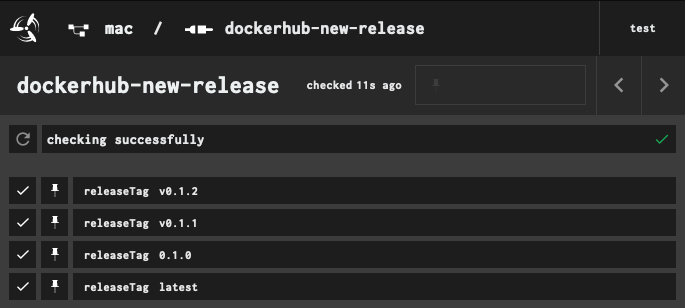
-
The modified Dockerfile requires
jq,wgetand the contents of theassetsfolder of this repo and uses the hardened container the Assurance team maintains as the base image. -
See cg-provision for an example of usage
resource_types:
  - name: http-jq-resource
    type: registry-image
    source:
      aws_access_key_id: ((ecr_aws_key))
      aws_secret_access_key: ((ecr_aws_secret))
      repository: concourse-http-jq-resource
      aws_region: us-gov-west-1
      tag: latest
resources:
  - name: check-s3-cidr-ranges
    type: http-jq-resource
    debug: true
    source:
      base_url: https://ip-ranges.amazonaws.com/ip-ranges.json
      jq_filter: '[.prefixes[] | select(.service=="S3") | select(.region=="us-gov-west-1")] | [.[].ip_prefix] | sort | {"range" : join("__")}'
-
The output needs to be in a single
key: valueformat, otherwise Concourse interprets each row returned as separate "new" versions. In the example above, all the ip addresses are sorted and concatenated so a single row is returned. -
jq_filterrequire trial and error to get right. Enablingdebug: truein theresourcesblock will emit details of thecheckscript. -
The
checkscript attempts to format the results, in particular the| jq -Msat the end has a tendency to make creatingjq_filtervalues difficult to configure. Enable the debugging to assist if you run into problems withjq_filtervalues. -
There is a Concourse pipeline named
concourse-http-jq-resourcethat deploys the Dockerfile found in this repo. There is noci/folder in this repo because the pipeline is controlled bycommon-pipelines.