Overview
At the moment, there are two SDK resolvers, both of which assume that the SDKs are on disk. It would be very useful to have SDKs resolved as NuGet packages as well which would allow third party SDKs to be acquired.
Related issues:
User Experience
Users would have to opt into the new behavior by specifying a version of the SDK to use. The resolver would never automatically get the latest because this would introduce very non-deterministic builds.
Users could control the version on a per-project basis:
<Project Sdk="My.Custom.Sdk/2.3.4">
  ...
</Project>
In this example, a NuGet package named My.Custom.Sdk version 2.3.4 would be retrieved and imported.
It would scale much better if users could specify a version per SDK for the whole repository. They could do this in their global.json:
{
  "sdk" : {
    "version:" "1.0.0"
  },
  "msbuild-sdks": {
    "My.Custom.Sdk" : "2.3.4"
  }
}
The sdk object controls which version of the .NET CLI to use and the msbuild-sdks object controls which versions of the MSBuild SDKs to use. If the resolver detected that multiple versions of the same SDK are requested for the same build episode, a warning would be logged and the first version specified would be used.
MSB4528: warning: A version of the SDK 'My.Custom.Sdk' was already specified in 'D:\Foo\global.json'. The version specified at 'C:\Foo\bar.csproj (1.7)' was ignored.
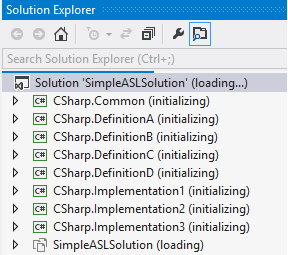
In Visual Studio, users would see projects in a Loading state while SDKs are resolved. Any errors that occur during acquisition would be reported in the Output window just like other package restore or build errors. Projects would fail to load if an SDK could not be resolved. Users could fix the issue and reload the project in Visual Studio.
Since the SDKs would be NuGet packages, the standard caching mechanisms and configurations would be in place. Users would control which feeds to use and other NuGet settings in their NuGet.config.
Implementation
If time permits, I'd like to add a command-line argument like /resolver which would allow users to specify custom resolvers to address #2278. Repository owners could control resolvers with Directory.Build.rsp. Resolvers would not be able to be specified in an import because resolvers load before projects are evaluated.


Overview
At the moment, there are two SDK resolvers, both of which assume that the SDKs are on disk. It would be very useful to have SDKs resolved as NuGet packages as well which would allow third party SDKs to be acquired.
Related issues:
User Experience
Users would have to opt into the new behavior by specifying a version of the SDK to use. The resolver would never automatically get the latest because this would introduce very non-deterministic builds.
Users could control the version on a per-project basis:
In this example, a NuGet package named
My.Custom.Sdkversion2.3.4would be retrieved and imported.It would scale much better if users could specify a version per SDK for the whole repository. They could do this in their
global.json:{ "sdk" : { "version:" "1.0.0" }, "msbuild-sdks": { "My.Custom.Sdk" : "2.3.4" } }The
sdkobject controls which version of the .NET CLI to use and themsbuild-sdksobject controls which versions of the MSBuild SDKs to use. If the resolver detected that multiple versions of the same SDK are requested for the same build episode, a warning would be logged and the first version specified would be used.In Visual Studio, users would see projects in a Loading state while SDKs are resolved. Any errors that occur during acquisition would be reported in the Output window just like other package restore or build errors. Projects would fail to load if an SDK could not be resolved. Users could fix the issue and reload the project in Visual Studio.
Since the SDKs would be NuGet packages, the standard caching mechanisms and configurations would be in place. Users would control which feeds to use and other NuGet settings in their
NuGet.config.Implementation
Projectconstructor to return and be notified when its ready. We already added aProjectEvaluationFinishedevent.SdkorMSBuildSdk. This could help differentiate the packages so that users don't attempt to add aPackageReferenceto something likeMicrosoft.NET.Sdk. Create new package type for MSBuild project SDKs NuGet/Home#6484a. The resolver would ship with MSBuild so that the functionality is always available since it would be a core piece of project evaluation. It could be a new assembly or be in
Microsoft.Build.dllmsbuild-sdkssection ofglobal.json. Add documentation for using MSBuild project SDKs MicrosoftDocs/visualstudio-docs#487If time permits, I'd like to add a command-line argument like
/resolverwhich would allow users to specify custom resolvers to address #2278. Repository owners could control resolvers withDirectory.Build.rsp. Resolvers would not be able to be specified in an import because resolvers load before projects are evaluated.